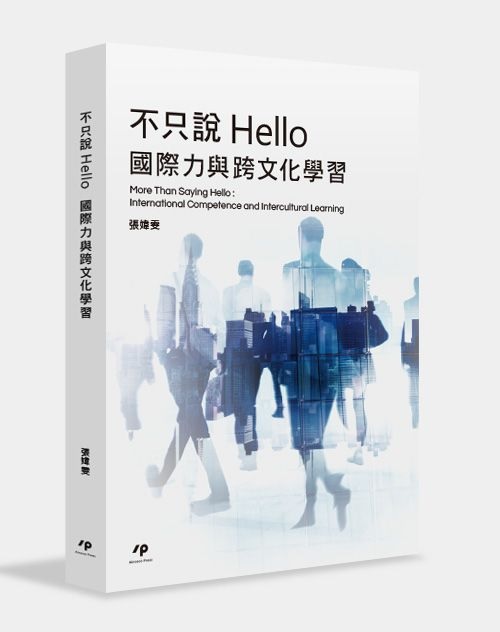
不只說 Hello:國際力與跨文化學習
Assessed as an outstanding academic book by external reviewers at National Taiwan Normal University.
Academic books, book chapters, and journal articles, with links to research projects and publication pages where available.
Assessed as an outstanding academic book by external reviewers at National Taiwan Normal University.
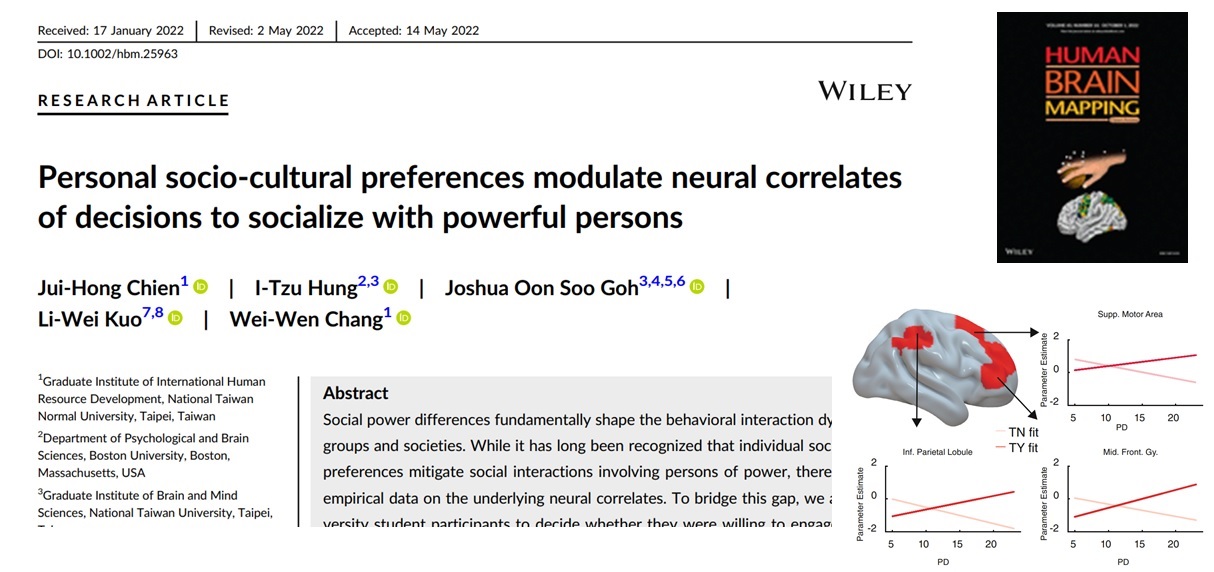
A cultural neuroscience publication connecting socio-cultural preferences and social decision-making.

An interdisciplinary article using expressive prosody and intrinsic brain connectivity.
張媁雯(2021)。不只說 Hello:國際力與跨文化學習。華藝學術出版社。
More than Saying Hello: International Competence and Intercultural Learning. Assessed as an outstanding academic book by external reviewers invited by National Taiwan Normal University.
Chang, W. W. (2026). Developing intercultural competence for business: Challenges and strategies. In L.-Y. Chen & C.-M. Tu (Eds.), New developments in Chinese for specific and professional purposes (pp. 19–44). Springer. https://doi.org/10.1007/978-981-95-5315-0_2
Chang, W. W. (2023). Developing leaders: What we can learn from the education, adult, and human resource development paradigm. In Oxford research encyclopedia of business and management. Oxford University Press. https://doi.org/10.1093/acrefore/9780190224851.013.388
Gunes, U., & Chang, W. W. (2023). Women leadership in the transcontinental country: A study in Turkey. In C.-H. Mayer, E. Vanderheiden, O. Braun-Lewensohn, G. Chen, K. Sueda, B. Mangolothi, S. Safdar, & S. Kim (Eds.), Women's empowerment for a sustainable future: Transcultural and positive psychology perspectives (pp. 439–455). Springer. https://doi.org/10.1007/978-3-031-25924-1_27
Yeh, C. C. R., Chang, W. W., & Wong, C. C. (2021). The impact of artificial intelligence on work and human value: Views from social researchers. In L. Uden, I.-H. Ting, & K. Wang (Eds.), Knowledge management in organizations (pp. 419–428). Springer. https://doi.org/10.1007/978-3-030-81635-3_34
Yeh, C. C. R., Wong, C. C., Liang, C. C. A., & Chang, W. W. (2021). Will robots take my job? Exploring the effect of artificial intelligence in Taiwan's labor market. In L. Uden, I.-H. Ting, & K. Wang (Eds.), Knowledge management in organizations (pp. 444–456). Springer. https://doi.org/10.1007/978-3-030-81635-3_36
Gunes, U., & Chang, W. W. (2025). Women's pathways to leadership: A bibliometric review and qualitative inquiry into career progression in Turkey. Women's Studies International Forum, 110, Article 103098.
Chien, J. H., Hung, I. T., Goh, J. O. S., Kuo, L. W., & Chang, W. W. (2022). Personal socio-cultural preferences modulate neural correlates of decisions to socialize with powerful persons. Human Brain Mapping, 43(14), 4422–4432.
Tsai, F. S., Chang, W. W., & Lee, C. C. (2022). A social condition-enhanced network for recognizing power distance using expressive prosody and intrinsic brain connectivity. IEEE Transactions on Multimedia, 24, 2046–2057.
張媁雯(2021)。雙語國家政策與我國雙語公務人才之培育。國家菁英季刊,14(1),1–17。(中文)
Bilingual national policy and the cultivation of bilingual public servants. National Elite Quarterly, 14(1), 1–17. (In Chinese).
Yeh, C. C. R., Wong, C. C. J., Chang, W. W., & Lai, C. C. S. (2020). Labor displacement in artificial intelligence era: A systematic literature review. Taiwan Journal of East Asian Studies, 17(2), 25–75.
Chang, W. W. (2017). Approaches for developing intercultural competence: An extended learning model with implications from cultural neuroscience. Human Resource Development Review, 16(2), 158–175.
Weng, H. C. J., & Chang, W. W. (2017). Shaping organizational culture by using work songs as a ritual: A case study of the Zonson Sports Corporation in China. International Journal of Information and Management Sciences, 28(4), 367–387.
Rodriguez, N., & Chang, W. W. (2017). The relationship among training and development, compensation, job stress, job satisfaction and organizational commitment: A study of a commercial bank in Honduras. Journal of International Cooperation, 12(1), 37–60.
Chang, W. W., Huang, C. M., & Kuo, Y. C. (2015). Design of employee training in Taiwanese nonprofits. Nonprofit and Voluntary Sector Quarterly, 44(1), 25–46.
Cho, Y., McLean, G. N., Amornpipat, I., Chang, W. W., Hewapathirana, G. I., Horimoto, M., Lee, M. M., Li, J., Manikoth, N. N., Othman, J., & Hamzah, S. R. (2015). Asian women in top management: Eight country cases. Human Resource Development International, 18(4), 407–428.
Lin, Y. C., & Chang, W. W. (2014). Retrospective on the 12th International Conference of the Academy of Human Resource Development (Asia Chapter) in Taipei, Taiwan: New perspectives of HRD and social networking in a globalizing workplace. Human Resource Development International, 17(3), 366–372.
Chang, W. W. (2014, September). Creating astonishing training: Marvel design principles. TTQS Electronic Journal. (In Chinese).
Chang, W. W., Yuan, Y. H., & Chuang, Y. T. (2013). The relationship between international experience and cross-cultural adaptability. International Journal of Intercultural Relations, 37(2), 268–273.
Chang, W. W., Chen, C. H. L., Huang, Y. F., & Yuan, Y. H. (2012). Exploring the unknown: International service and individual transformation. Adult Education Quarterly, 62(3), 230–251.
Casey, V., Lee, P. P., & Chang, W. W. (2012). Job stress and organizational commitment of teachers at denominational and government secondary schools in Belize. Journal of International Cooperation, 7(2), 151–168.
Raquel, A. P., Lee, P. P., & Chang, W. W. (2012). International experience, pre-departure cross-cultural preparation, personality, social support, and multicultural competence. Journal of International Cooperation, 7(1), 73–90.
Chang, W. W. (2010, April). Is the group activity food or poison in a multicultural classroom? Training & Development, 34–37.
Chang, W. W., Zhuang, Y., Yuan, Y., & Zhang, T. (2009). Analysis of the application of the intercultural adaptability assessment scale in Chinese. Journal of Business Management, 83, 99–152. (In Chinese).
Chang, W. W. (2009). Schema adjustment in cross-cultural encounters: A study of expatriate international aid service workers. International Journal of Intercultural Relations, 33(1), 57–68.
Chang, W. W. (2009). Cross-cultural adjustment in the multinational training programme. Human Resource Development International, 12(5), 561–569.
Bodden Gillett, B., & Chang, W. W. (2009). Strategies used by principals to motivate teachers in secondary institutions in Belize. Journal of International Cooperation, 4(1), 83–100.
Chang, W. W. (2009). Intercultural experience and adaptation: A study of Taiwan's international aid cooperation personnel dispatched abroad. Journal of the Third Sector, 12, 33–62. (In Chinese).
Chang, W. W. (2007). Cultural competence of international humanitarian workers. Adult Education Quarterly, 57(3), 187–204.
Chang, W. W. (2007). The negative can be positive for cultural competence. Human Resource Development International, 10(2), 225–231.
Chang, W. W. (2005). Expatriate training in international nongovernmental organizations: A model for research. Human Resource Development Review, 4(4), 440–461.
Chang, W. W. (2004). A cross-cultural case study of a multinational training program in the United States and Taiwan. Adult Education Quarterly, 54(3), 174–192.
Chang, W. W. (2003). Considering the limitation of etic approaches in cross-cultural study. Human Resource Development Quarterly, 14(4), 483–485.